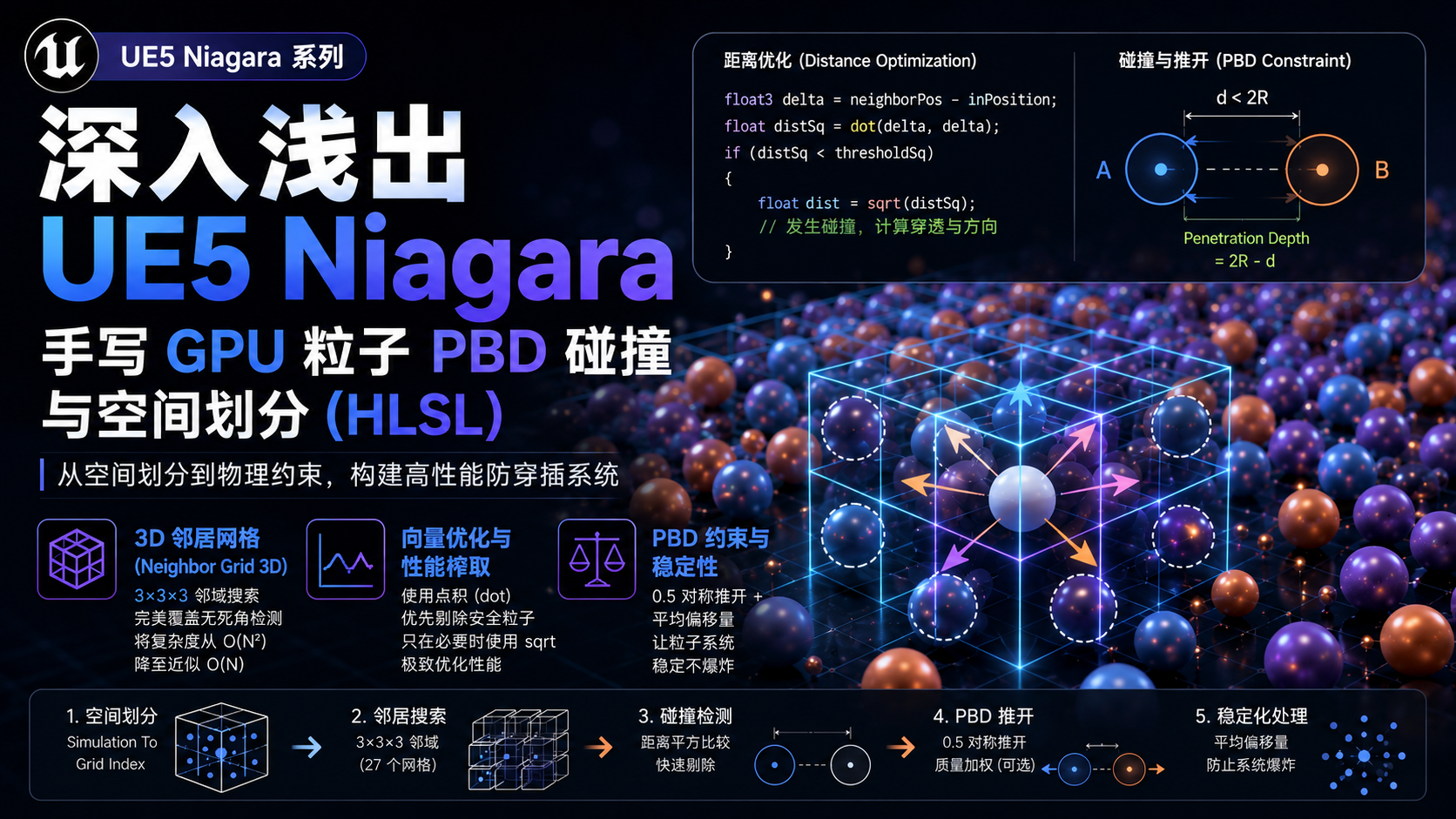
在虚幻引擎 (UE5) 的 Niagara 系统中,当我们需要让成千上万个 GPU 粒子拥有”体积感”并防止互相穿模时,传统的物理引擎往往会力不从心。这时候,我们需要利用**基于位置的动力学(Position-Based Dynamics, 简称 PBD)配合3D 邻居网格(Neighbor Grid 3D)**来手写一个高性能的约束求解器。
本文将拆解一段用于 Niagara Custom HLSL 节点的粒子防穿插代码,从零解析空间划分、向量数学优化以及物理约束的稳定性。
1. 完整 HLSL 源码
这段代码通常放在粒子的 Particle Update 阶段。它会计算出一个 outPenetrationOffset(穿透偏移量),随后你可以将这个向量累加到粒子的 Position 上,实现硬约束避让。
// 初始化输出的穿透偏移量
outPenetrationOffset = float3(0.0, 0.0, 0.0);

#if GPU_SIMULATION
// 1. 获取当前粒子在 3D 网格中的坐标信息
float3 UnitPos = float3(0.0, 0.0, 0.0);
inNeighborGrid3D.SimulationToUnit(inPosition, inWorldToUnitMatrix, UnitPos);

int3 CellIndex = int3(0,0,0);
inNeighborGrid3D.UnitToIndex(UnitPos, CellIndex.x, CellIndex.y, CellIndex.z);

int3 NumCells = int3(0,0,0);
inNeighborGrid3D.GetNumCells(NumCells.x, NumCells.y, NumCells.z);

int MaxNeighborsCount = 0;
inNeighborGrid3D.MaxNeighborsPerCell(MaxNeighborsCount);

int CollisionCount = 0;

// 2. 遍历当前粒子所在的网格,以及周围相邻的共计 27 个网格 (3x3x3)
for (int x=-1; x<=1; x++)
{
    for (int y=-1; y<=1; y++)
    {
        for (int z=-1; z<=1; z++)
        {
            const int3 CellIndexToCheck = CellIndex + int3(x,y,z);

            // 边界检查
            if (CellIndexToCheck.x >= 0 && CellIndexToCheck.x < NumCells.x &&
                CellIndexToCheck.y >= 0 && CellIndexToCheck.y < NumCells.y &&
                CellIndexToCheck.z >= 0 && CellIndexToCheck.z < NumCells.z )
            {
                // 3. 遍历该有效网格内的所有邻居粒子
                for (int i = 0; i < MaxNeighborsCount; i++)
                {
                    int NeighborLinearIndex = 0;
                    inNeighborGrid3D.NeighborGridIndexToLinear(CellIndexToCheck.x, CellIndexToCheck.y, CellIndexToCheck.z, i, NeighborLinearIndex);

                    int NeighborIndex = 0;
                    inNeighborGrid3D.GetParticleNeighbor(NeighborLinearIndex, NeighborIndex);

                    // 剔除无效索引与自身
                    if (NeighborIndex == -1 || NeighborIndex == inExecutionIndex) continue;

                    float3 NeighborPosition = float3(0.0, 0.0, 0.0);
                    bool bNeighborPositionValid = false;
                    inAttributeReader.GetPositionByIndex<Attribute="Position">(NeighborIndex, bNeighborPositionValid, NeighborPosition);

                    if (!bNeighborPositionValid) continue;

                    // 4. 碰撞与距离计算
                    const float3 DeltaPosition = NeighborPosition - inPosition;
                    const float SqrdDistanceToNeighborParticle = dot(DeltaPosition, DeltaPosition);

                    // 规避完全重合点,防止除零错误
                    if (SqrdDistanceToNeighborParticle < 0.0001) continue;

                    const float CollisionDistanceThreshold = inParticleCollisionRadius * 2.0;
                    const float CollisionDistanceThresholdSqrd = CollisionDistanceThreshold * CollisionDistanceThreshold;

                    // 检测到重叠(穿透)
                    if (SqrdDistanceToNeighborParticle < CollisionDistanceThresholdSqrd)
                    {
                        const float DistanceToNeighborParticle = sqrt(SqrdDistanceToNeighborParticle);
                        const float3 DirectionToNeighborParticle = DeltaPosition / DistanceToNeighborParticle;

                        CollisionCount++;

                        // 计算穿透深度,乘以 0.5 让双方各承担一半位移
                        const float PenetrationDepth = CollisionDistanceThreshold - DistanceToNeighborParticle;
                        outPenetrationOffset -= DirectionToNeighborParticle * (PenetrationDepth * 0.5);
                    }
                }
            }
        }
    }
}

// 5. 多重碰撞的稳定化处理
if (CollisionCount > 0)
{
    // 求平均偏移量,防止密集状态下引发系统爆炸
    outPenetrationOffset /= CollisionCount;
}
#endif
2. 核心原理解析
🗺️ 空间划分与 3x3x3 邻居遍历
如果场景中有 10,000 个粒子,两两计算距离需要一亿次操作($O(N^2)$),GPU 会直接宕机。
Niagara 的 NeighborGrid3D 通过空间哈希(Spatial Hashing)解决了这个问题:
- 坐标离散化: 将连续的物理坐标映射为离散的 3D 数组索引。
- 解决边界缺陷: 代码中使用了三层
for循环遍历周围 27 个网格($3 \times 3 \times 3$)。这是因为如果粒子正好处于网格边界,它可能会漏掉处于相邻网格但物理距离极近的粒子。只要保证网格边长大于粒子的碰撞直径,搜索 $3 \times 3 \times 3$ 就能实现完美的无死角检测。
⚡ 向量数学与性能榨取
在 GPU 编程中,开方运算 (sqrt) 是极其昂贵的。
为了优化性能,代码使用了点积 (dot) 来计算距离的平方:
$$d^2 = \vec{v} \cdot \vec{v}$$ $$d^2 < (2R)^2$$
通过优先比较”距离的平方”和”阈值的平方”,我们可以快速剔除绝大多数安全的粒子,只有在确认发生碰撞的 if 语句内部,才付出代价去计算真正的 sqrt 来获取方向向量和穿透深度。
⚖️ PBD 物理约束与系统稳定
在 GPU 的高度并行计算中,如果不加限制,物理模拟会极易”爆炸”。代码中有两处关键的”稳定器”:
- 乘以
0.5(防过度补偿): 如果粒子 A 和 B 重叠了 10 个单位,它们的线程会同时计算推开逻辑。如果不用 0.5,A 会退 10 步,B 会退 10 步,下一帧它们就拉开了 20 个单位,造成剧烈抖动。乘以 0.5 可以让双方”AA制”,各自承担一半的修正。 - 除以
CollisionCount(雅可比迭代法则): 当一个粒子在粒子堆中心被 6 个邻居同时挤压时,粗暴累加偏移量会赋予它极大的位移,导致粒子堆”爆炸”。除以碰撞次数,相当于取所有建议的”平均折中位置”,能极大提升粒子簇的稳定性。
3. 进阶探讨:质量不同的粒子怎么相撞?
代码中的 0.5 是基于所有粒子”质量相同”的假设。如果粒子大小不一,比如一个保龄球和一个乒乓球相撞,我们需要引入质量倒数(Inverse Mass) $w = 1 / m$ 来动态计算推开比例:
$$Ratio = \frac{w_{current}}{w_{current} + w_{neighbor}}$$
在 HLSL 中,这可以写成:
// 动态计算推开系数,轻的粒子承担更多位移,重的粒子如泰山不动
const float PushRatio = InvMassCurrent / (InvMassCurrent + InvMassNeighbor);
outPenetrationOffset += DirectionToNeighborParticle * -(PenetrationDepth * PushRatio);